Haven's sacrificial order
The Passage (Justin Cronin Edition)Haven’s sacrificial order is a recurring bargain with Babcock: four cattle and two people are surrendered at each new moon so that the Many remain at bay. The arrangement has sustained the settlement’s survival while making that survival depend on repeated human loss; Olson’s account reveals both the cost to individual families and the residents’ effort to escape the bargain by killing Babcock.
Terms and Purpose
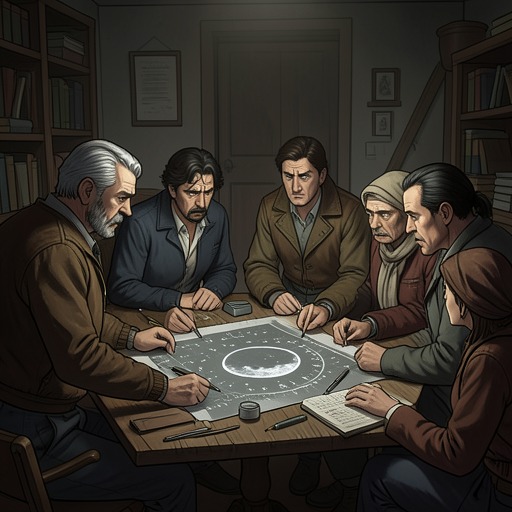
The sacrifice takes place in the prison’s central courtyard, known as the ring. The plan described by Olson assigns distinct routes to its participants: Babcock enters through the opening in the roof, while the four cattle are driven from the opposite end through a gap in the fireline, followed by the two people selected for the offering. Olson states the recurring terms plainly: four animals and two people at every new moon. In return, Babcock keeps the Many away.
The Many are the other virals associated with Babcock, described as belonging to his blood. Peter initially questions whether Babcock can control them. Olson’s explanation goes further: Babcock does not merely command the Many but is them. The bargain therefore rests not on a simple exchange with an independent ruler, but on the claim that Babcock and the threat held back by the sacrifice are inseparable.
A Survival Strategy and Its Human Cost
Olson says the inhabitants have lived under this arrangement for as long as they can remember. They have understood it as their only way to survive, and many regard the ring as a small price to pay. His explanation presents the practice as a collective calculation under extreme pressure, but that calculation does not erase the individual cost: people are selected and sent into the ring, while the community’s security depends on accepting their loss.
The toll reaches Olson’s own family. He had a son as well as Mira; his son would have been about Peter’s age had he lived. When the boy was chosen, his mother objected, but Jude sent her into the ring with him. Olson’s position is therefore not detached: he has surrendered his own child to the system he explains. Alicia calls the residents collaborators and compares them to pets, naming the moral degradation she sees in a community that submits to Babcock for protection. Olson does not deny the accusation; he says he has made it against himself many times.
Recruitment, Memory, and the Ring
The sacrificial order is sustained alongside the settlement’s efforts to bring in additional people. Olson recounts that patrols were sent out for many years to gather others. Some arrived on their own, while others were left by the virals for the residents to find; Sara is named as one such person. Sara says she cannot remember what happened to her. Olson responds that no one remembers, because the trauma is too great.
This account connects the ring’s violence to a wider pattern of loss and obscured memory. The people brought into Haven may not know how they arrived, while the established residents have learned to treat the ritual as an enduring condition of survival. The ring is not simply the site of a periodic offering: in Olson’s account, it is where Babcock’s power, the settlement’s dependence, and people’s traumatic histories meet.
Rebellion and the Order’s Breaking Point
Olson describes a group that has spent years preparing to leave the arrangement behind and live as people. Their intended break is not simply to refuse the next offering. As long as Babcock lives, Olson warns, he will call the Many; killing him is therefore the group’s stated objective and the reason they believe their weapons offer a chance. The planned assault divides the attackers between the floor and the catwalks above the ring, positioning them to confront Babcock as he enters through the roof opening.
The terms that once promised safety now reveal the settlement’s trap: each new moon renews the bargain, but dependence on Babcock leaves Haven exposed to the very force the ritual is meant to hold back. Olson’s testimony changes the meaning of the planned assault. It is an attempt to end an order that has made family loss part of communal survival, even though the evidence does not establish whether the revolt succeeds. The unresolved question of who is in the ring leaves the immediate human cost uncertain, while the group’s decision to target Babcock marks the clearest challenge yet to Haven’s sacrificial compact.